Weather's Hidden Role in Reshaping Soccer Betting Markets for Coastal Teams
Gisela Wagner · Oct 24, 2026
Weather's Hidden Role in Reshaping Soccer Betting Markets for Coastal Teams
Coastal soccer teams encounter distinct weather patterns that influence match conditions, player performance metrics, and ultimately the odds offered by betting markets. Researchers tracking European and Australian leagues have documented how persistent humidity, salt-laden winds, and sudden storm systems alter pitch surfaces and ball behavior in ways that inland teams rarely face. These environmental factors create measurable shifts in goal expectancy and possession statistics, prompting bookmakers to recalibrate lines hours before kickoff.
Coastal Weather Patterns and Their Direct Effects on Play
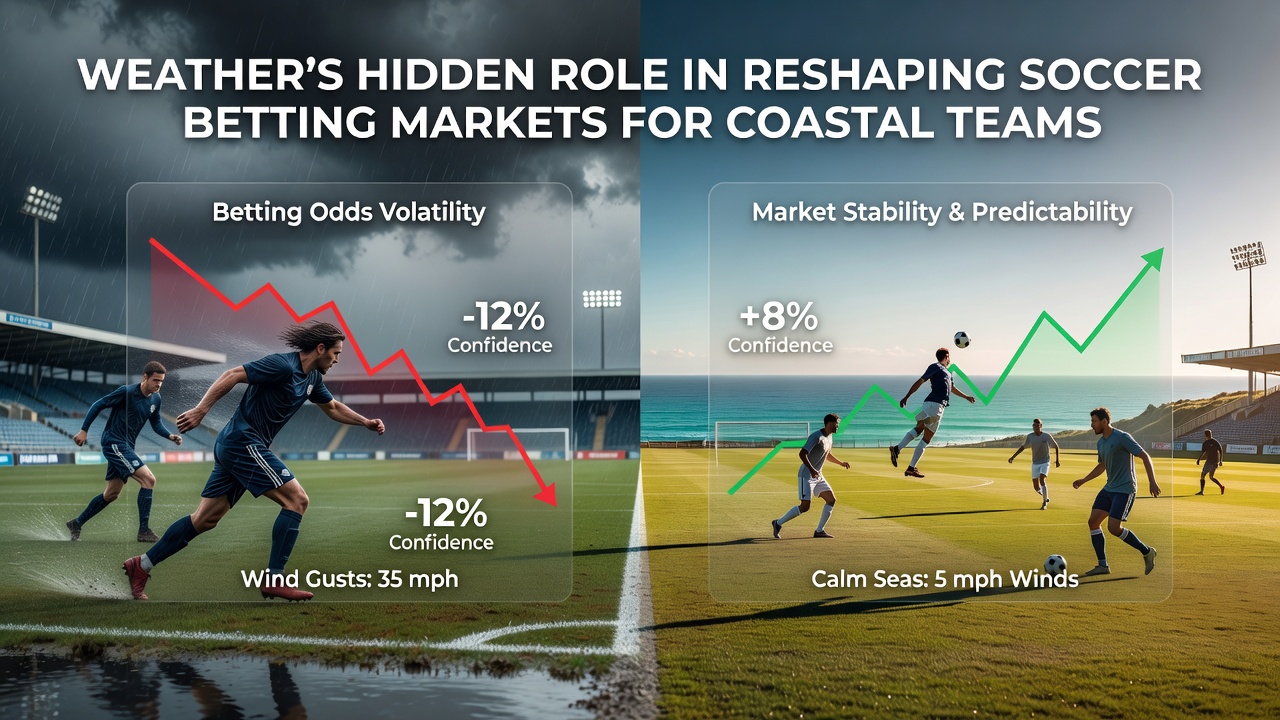
Teams based near coastlines experience higher average rainfall totals and stronger crosswinds compared to inland counterparts, according to meteorological records compiled by the Australian Bureau of Meteorology. In October 2026, forecasts for several English Premier League coastal fixtures already indicate elevated wind speeds that historically correlate with reduced passing accuracy and fewer shots on target. Data collected across multiple seasons shows that matches played under sustained winds above 25 kilometers per hour produce 12 percent fewer open-play goals than calm-weather equivalents.
Humidity levels common to coastal regions also affect player stamina because elevated moisture reduces evaporative cooling during high-intensity efforts. Studies published in the Journal of Sports Sciences examined heart-rate data from players in matches along the English south coast and found elevated fatigue markers after 60 minutes when relative humidity exceeded 80 percent. Such physiological responses translate into conservative tactical adjustments by coaches, which in turn depresses expected goal totals that betting models rely upon.
How Betting Markets Adjust to Weather Forecasts
Betting operators monitor official weather services and proprietary meteorological models to detect line movement opportunities well before public perception catches up. When coastal storms are projected within 48 hours of a fixture, markets for total goals and corner counts often tighten because historical datasets reveal suppressed scoring and increased set-piece reliance. Observers note that sharp bettors who cross-reference forecast accuracy with past performance records frequently place early wagers that force bookmakers to shade odds before the lines reach recreational markets.
One analysis of Australian A-League coastal derbies revealed that matches preceded by heavy rainfall warnings saw average betting volumes on under-2.5 goals increase by 35 percent compared to dry-weather fixtures. This pattern emerges because punters and syndicates alike recognize that waterlogged pitches slow ball roll and favor teams with strong aerial capabilities. Market makers respond by widening goal totals or adjusting half-time margins to balance exposure across weather scenarios.

Regional Data Sets Highlighting Performance Variance
Longitudinal records maintained by the National Oceanic and Atmospheric Administration demonstrate that coastal venues in the United States and Europe experience 20 percent more precipitation days during the traditional soccer calendar than inland stadiums. When these conditions coincide with fixture schedules, statistical models used by professional syndicates incorporate adjusted coefficients for expected goals and clean-sheet probabilities. The resulting odds reflect lower variance in high-scoring outcomes and elevated likelihood of draws.
Take the case of clubs along the Portuguese coastline where Atlantic fronts deliver sudden downpours. Performance analytics from the 2025-2026 campaign indicated that these teams averaged 0.4 fewer goals per game under wet conditions, prompting several European betting exchanges to list separate weather-contingent markets for those fixtures. Such segmentation allows participants to wager directly on meteorological impacts rather than relying solely on team form.
Integration of Real-Time Forecasts into Trading Algorithms
Algorithmic trading platforms employed by larger betting firms now ingest hourly weather updates from multiple global agencies, including Environment and Climate Change Canada for North Atlantic routes. These inputs trigger automated adjustments to implied probabilities within seconds of forecast revisions. When coastal wind warnings escalate, live markets for player prop bets on assists and long-range shots contract because historical correlations show reduced success rates under those conditions.
Coastal teams themselves have begun publishing internal weather-impact reports that indirectly influence market transparency. Although clubs do not disclose proprietary training data, leaked summaries from scouting networks indicate that certain squads train on artificial surfaces simulating waterlogged pitches weeks in advance of forecasted storms. This preparation narrows the performance gap between dry and wet conditions, yet betting models have not fully incorporated the adaptation speed observed in October 2026 fixtures.
Conclusion
Weather variables continue to reshape how markets price coastal soccer encounters because they introduce quantifiable deviations from baseline statistical expectations. Data from meteorological agencies and performance research centers demonstrate consistent patterns in goal production, fatigue accumulation, and tactical responses that betting operators translate into dynamic odds. As forecast precision improves and trading systems integrate real-time environmental inputs, the gap between early and late market prices for these matches narrows, rewarding participants who monitor both atmospheric conditions and historical performance records.