Examining Travel Fatigue Metrics and Their Bearing on Performance Indicators for Cross-Continental Soccer Contests
Gisela Wagner · Sep 12, 2026
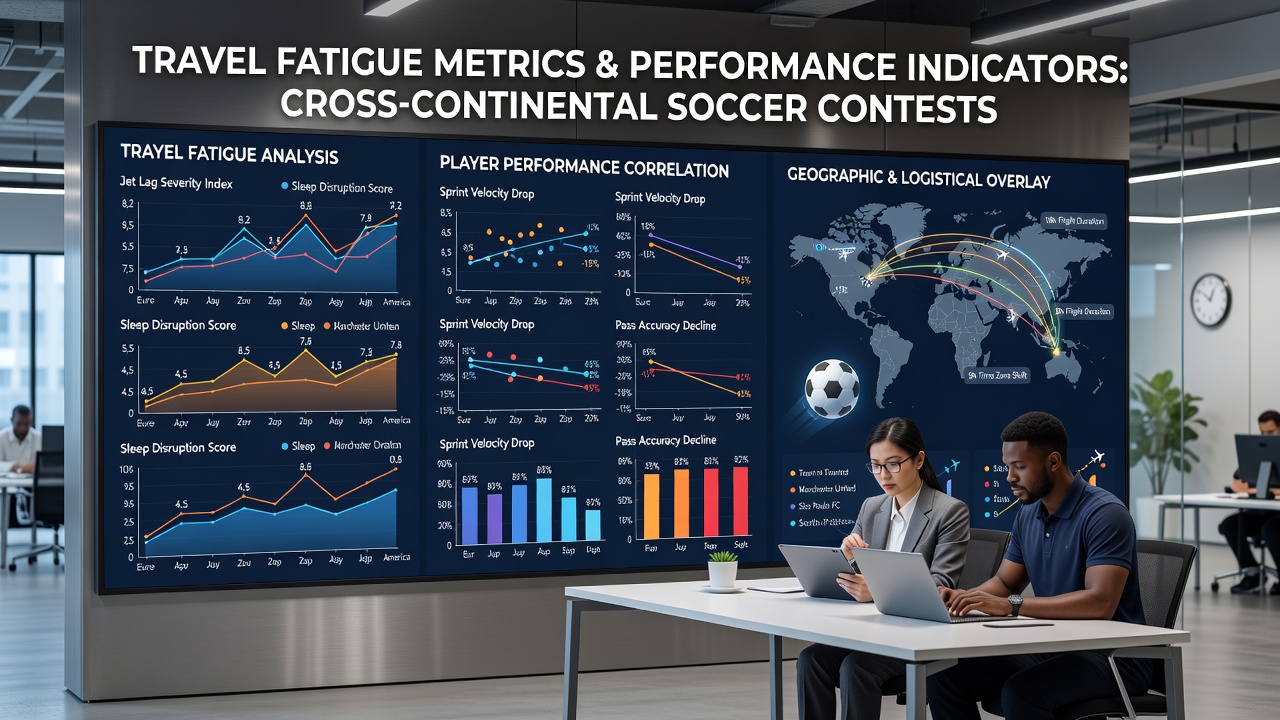
Examining Travel Fatigue Metrics and Their Bearing on Performance Indicators for Cross-Continental Soccer Contests
Cross-continental soccer travel introduces measurable disruptions to player physiology that teams track through standardized fatigue metrics, and these numbers connect directly to performance data collected during matches. Researchers measure factors such as hours spent in flight, number of time zones crossed, sleep duration logged via wearable devices, and circadian rhythm shifts recorded in pre- and post-travel assessments. Performance indicators tracked in the same studies include total distance covered, high-intensity sprints, pass completion rates, and recovery intervals between efforts.
Data collected from professional squads show that flights exceeding eight hours correlate with reductions in high-speed running output during the first half of subsequent matches, while crossings of five or more time zones align with slower reaction times in defensive actions. European clubs competing in the FIFA Club World Cup and South American sides traveling to UEFA competitions supply much of the available longitudinal information, because these fixtures require repeated long-haul journeys within a single season.
Key Metrics Used to Quantify Travel Fatigue
Teams and performance staff rely on a core set of variables that appear consistently across published protocols. Flight duration and departure-arrival clock times form the baseline, while wrist-worn actigraphy devices record actual sleep time adn sleep efficiency on the aircraft and in the first nights after arrival. Salivary cortisol samples taken at standardized intervals provide a hormonal marker of stress load, and subjective wellness questionnaires capture muscle soreness and perceived recovery on validated scales.
These inputs feed into composite fatigue scores that clubs compare against GPS and heart-rate data gathered in training and matches. When composite scores rise above established thresholds, analysts note corresponding drops in acceleration counts and increases in error rates on short passes. The same datasets reveal that eastward travel tends to produce larger immediate decrements than westward journeys of equivalent distance, a pattern attributed to the compression of the circadian cycle.
Performance Indicators Affected by Extended Journeys
Match statistics compiled from cross-continental fixtures indicate several repeatable shifts. Total distance covered by midfielders declines on average during the opening thirty minutes after arrival plus forty-eight hours, and the number of explosive efforts above twenty-five kilometers per hour shows a similar pattern. Goalkeepers exhibit measurable increases in distribution error rates on the day after long-haul flights, particularly when the destination lies more than six time zones away from the departure city.
Injury surveillance programs run by league medical officers record elevated soft-tissue complaint rates in the seventy-two hours following such travel, although the absolute numbers remain modest. Set-piece execution metrics, including corner conversion and free-kick accuracy, also register small but consistent reductions when teams play within three days of a transoceanic crossing. Analysts integrate these indicators into pre-match models that adjust expected goal values for both sides.

Case Examples from Recent Competitions
During the 2025 intercontinental club schedule, squads that crossed the Atlantic for midweek fixtures and returned for domestic league rounds demonstrated measurable recovery timelines. One study tracked a South American side that flew seventeen hours to a European venue and competed seventy-two hours later; the team logged 8 percent fewer high-intensity runs in the first half compared with its home-continent baseline. Return fixtures showed the opposite pattern once acclimatization occurred over five days.
Preparation for the 2026 FIFA World Cup, whose group stage begins in June, has already prompted national federations to publish travel protocols ahead of September 2026 qualification windows. Several confederations now schedule training camps at intermediate time zones to reduce the abruptness of final arrivals. These schedules appear in official competition circulars and allow medical staff to collect standardized baseline data before the tournament proper.
Monitoring Tools and Data Integration
Modern squads combine multiple streams into unified dashboards. GPS units sample at ten hertz to capture external load, while internal load comes from session rating of perceived exertion multiplied by duration. Sleep trackers feed nightly totals into algorithms that flag cumulative deficits. When thresholds trigger, staff adjust training intensity or suggest strategic rest periods before departure.
Academic groups have begun pooling anonymized datasets from multiple clubs under research ethics approvals. One collaboration involving the American College of Sports Medicine and several European performance departments released aggregate findings showing that circadian-adjusted scheduling reduces the magnitude of sprint decrements by measurable margins. Another project coordinated through the University of Western Australia examined return-to-play timelines after transpacific travel and identified consistent windows for full physical restoration.
Conclusion
Travel fatigue metrics now form an established component of performance analysis in cross-continental soccer. Flight parameters, sleep logs, hormonal markers, and wellness scores feed directly into models that predict shifts in distance covered, sprint volume, technical accuracy, and soft-tissue risk. As qualification cycles advance toward the 2026 FIFA World Cup, federations and clubs continue to refine scheduling and monitoring practices using the same data streams. The accumulated evidence supplies objective benchmarks that medical and performance staff apply when planning itineraries and recovery interventions for future intercontinental contests.